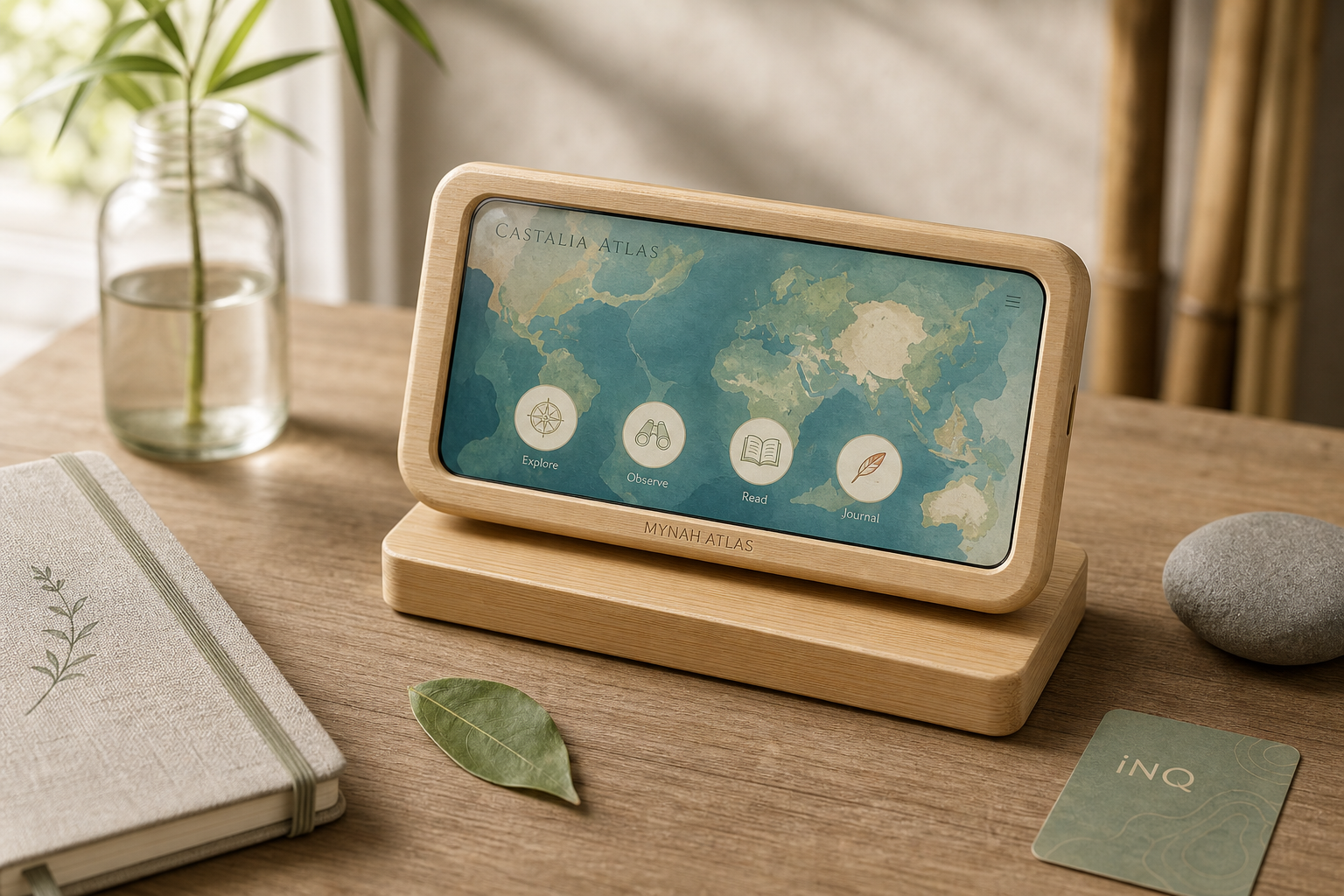
Mynah Atlas A16 in a rounded bamboo-filled enclosure on its dock beside a field notebook and iNQ card
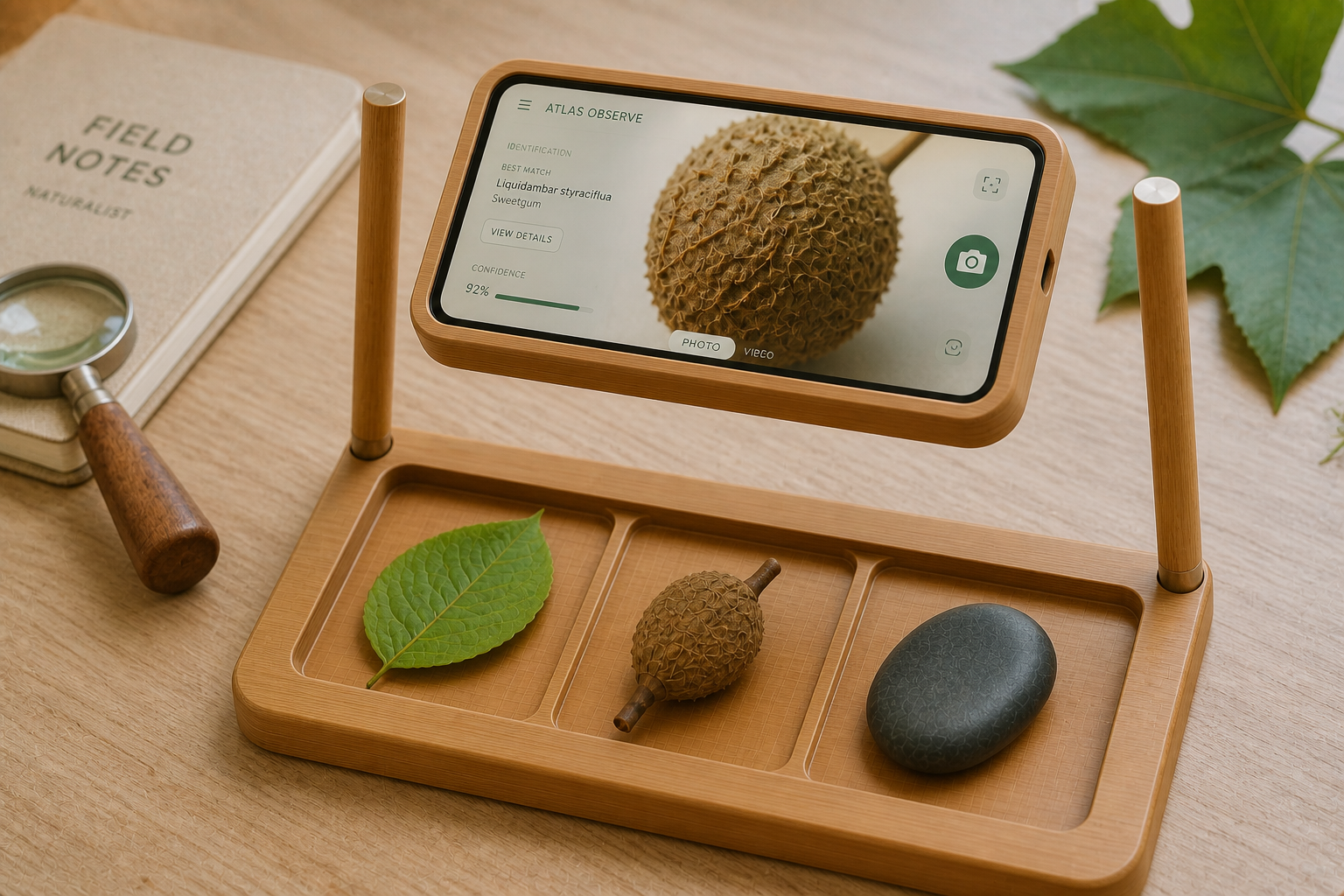
Mynah Atlas supported over its fitted bamboo observation tray, examining a leaf, seed pod, and stone
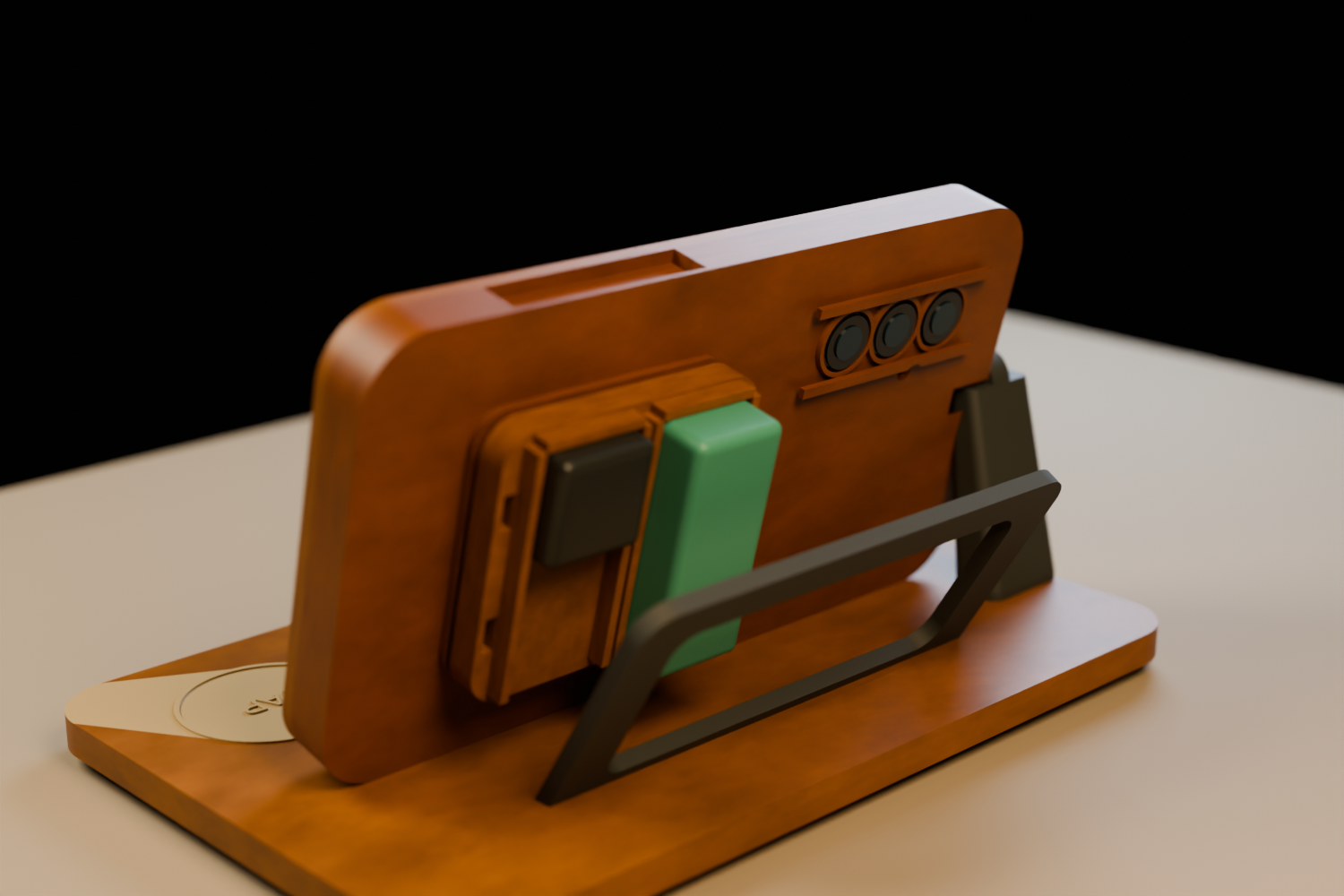
Rear view of the Atlas A16 bamboo enclosure with modular sensor backpack
Mynah

For families who learn in the world

Mynah

AI curriculum built from your child’s real life.

A child notices something. Mynah helps them identify it, talk about it, remember it, and then learn from it later.

Meet the first Mynah field device → Explore global packs →


The Moment That Started It

You have watched a child fall completely into a screen — during a lesson, after dinner, when the day was already full.

The speed.
The intensity.
How hard it is to call them back to the table.

The problem is not screens by themselves.

It is commercial software built for passive attention.

Mynah starts from what the child already noticed, then teaches from that moment later.


Designed for the Pace of Childhood — and Real Life

The loop is: see it, talk about it, remember it, and learn from it again.

No autoplay by design.
No infinite scroll competition.
No passive “watch one more” patterns.

Observe in the moment. Practice later with context.

Families and homeschool testers with early prototypes often report:

  • Learning that starts outside and continues at the table
  • Fewer screen-extension battles at transitions
  • Better carryover from encounter to reading, counting, and explaining
  • Cleaner transitions out of the activity

Children linger when there is less to chase.


Castalia early learning

Start with what a child can see, hold, and wonder about.

The iNQ Leaf, the Atlas Field Guide, and the Atlas device family are public pieces of a learning philosophy in development: physical prompts, calm digital tools, and room for the world outside the lesson.


Choose the shape of your learning loop

The same core loop across form factors: field discovery, conversation, memory, and later reinforcement.

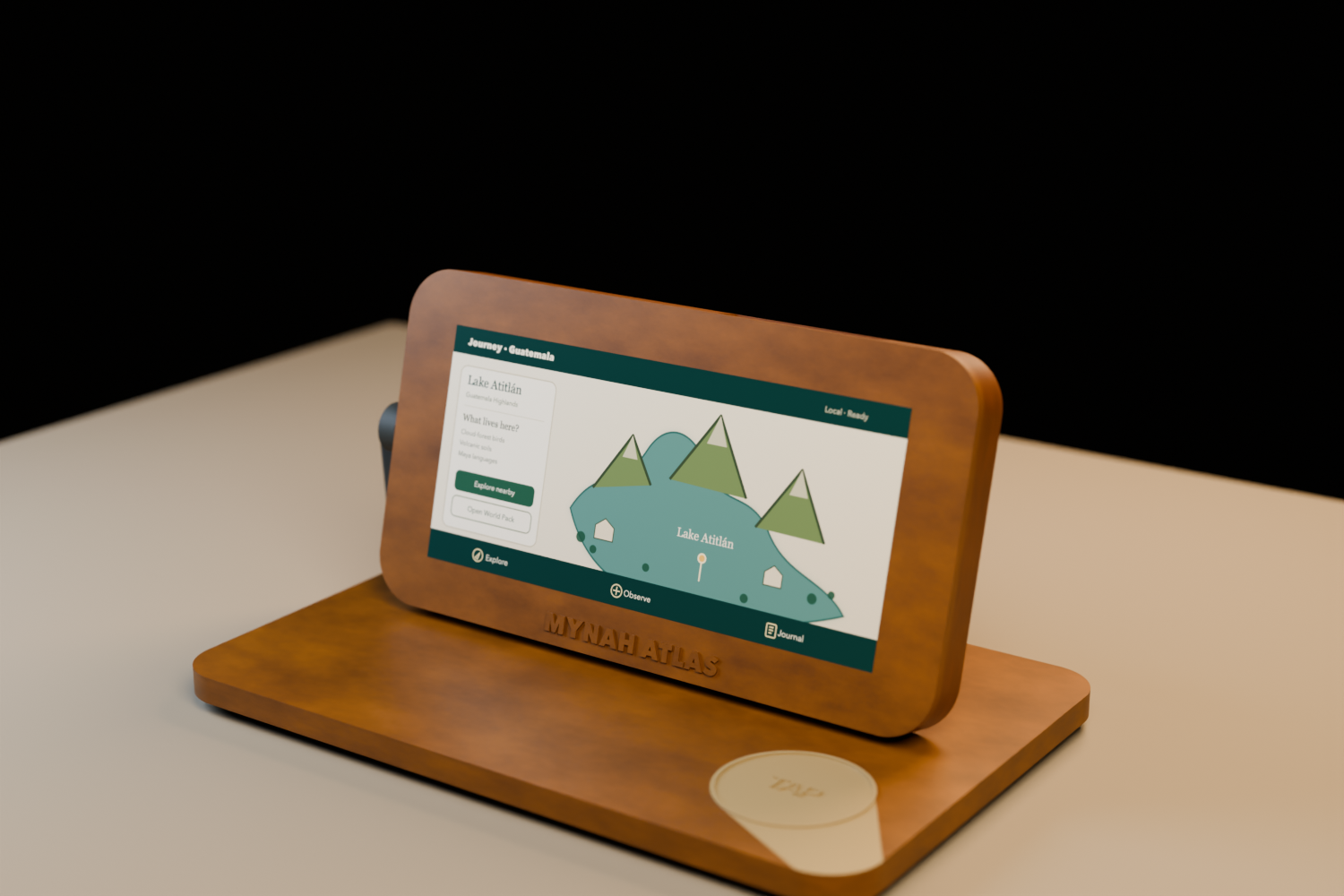
Mynah Atlas A16 on a bamboo dock showing an offline-ready Guatemala World Pack

Mynah core device

In development

Mynah Atlas A16

A replaceable Android field device and companion software stack for children to explore outdoors and come back to lessons later.

  • Real-world recognition and conversation loop
  • Persistent encounter memory
  • Offline fallback in field conditions
  • Replaceable phone module for repairability
  • Hands-on iNQ and optional sensor workflow
  • Family privacy and controls-first defaults

Atlas DS

Dual-screen clamshell for long-form work and narrations. Primary IPS for activities; secondary e-ink for status — battery, time, quiet cues. Folds like a book.

  • 7" IPS + 4.2" E-ink
  • Quad-core A55, 4GB RAM
  • 5000mAh, Wi-Fi 6, BT 5.2
Specs and details →

TriCorder

Pocketable handheld for trails, camps, and co-ops. Game Boy–scale body, physical d-pad and buttons, front camera for iNQ Card scanning — the carry-everywhere field unit.

  • 3.5" IPS, 480×320
  • Quad-core A53, 2GB RAM
  • 220g, 2MP camera
Specs and details →

Nature Identification Lab

Realtime field inference for rocks, fungi, plants, animals, and clouds. Pulls region guides from ArkGIS when available and returns evidence-based candidates with confidence and provenance.

  • GIS-region priors and fallback catalog
  • Evidence scoring + confidence labeling
  • Map-ready GeoJSON educational layer
Open identification lab →

Field Tablet

Shared-screen tablet for demos and read-alouds. 7" landscape, full kickstand, drop-tested housing — same firmware as the rest of the line in a single-screen body.

  • 7" IPS, landscape
  • 1-meter drop tested
  • Matte PC/ABS, kickstand
Specs and details →

Sense

Clip-on lab for science at home. Adds a camera, 9-axis IMU, and three M5Stack sensor ports so a tablet becomes a field instrument.

  • Camera + 9DOF IMU
  • 3× M5Stack Unit ports
  • Fits DS, Field Tablet, SP
Specs and details →

Inquiry Appliance

New

Target: $500

The household hub for Castalia: serve books and activities to your Atlas devices, run local AI where you want it, host iNQ Card libraries, and act as the terrAIn base station — all on your LAN, no cloud required.

Built on $400 of hardware; the retail margin funds firmware and operations. No recurring fee required to use the appliance itself.

  • Local AI inference (on-device models)
  • Content server for Atlas fleet
  • terrAIn base station compatible
  • iNQ Card library + QR resolver
  • No cloud dependency, no telemetry
  • $400 hardware / $500 retail

The engineering serves your child’s learning loop

No app-store gatekeeper, no behavior design overlays — only the loop your child is currently building.

You steer curriculum and software

No app-store gatekeeper deciding what counts as educational. No surprise updates that change defaults. What your child has encountered shapes what they practice next.

Learning data stays on your network

We are building toward local-first operation where learning history, activities, and media can stay on-family and avoid unnecessary cloud dependence.

Built for siblings and real life

Designed for active hands and uneven places: kitchen, patio, road trips, and backyard routines, not pristine demo spaces.

Hands-on hooks for digital lessons

iNQ Cards and encounter history let real objects, places, and questions appear again as tomorrow’s activity prompts.


First production cohort

Help us build the first run

If your child learns best when you connect ideas to real moments, join the founding cohort. No ad model, no engagement tricks, and a direct role in shaping what we ship.

Join the Founding Cohort

Build 33459927993